 by Dawn Magee
Halifax Just Tipped Into a Balanced Market
What buyers and sellers need to know right now
Halifax-Dartmouth hit 4.0 months of supply in September. That is the highest reading in the NSAR data going back to January 2021. It also moves the city out of seller’s territory and into a balanced market for the first time in that stretch.
Here’s the part I find most interesting about the Nova Scotia real estate market right now. Sellers aren’t flooding the market. Buyers are simply taking their time. I love real estate and research, so let’s dig into what that means for you.
The Big Picture: Nova Scotia Overall
Across the province, 828 homes sold in September. That is down 9.9% from a year ago and the slowest September since 2023.
There were 4,508 homes for sale at month end. That’s up 17.5% year over year and the highest count in the data back to 2021. Months of supply climbed to 5.7, up from 4.5 last September.
Now look at new listings. Year to date, 12,563 homes have been listed. Last year it was 12,568, basically identical. Sales, however, are down 8.7% year to date.
So inventory isn’t building because more people are selling. It’s building because fewer people are buying.
The provincial median price rose 3.5% to $445,000. Don’t read too much into that one. Halifax made up a bigger share of sales this month, and Halifax homes cost more. That mix pushes the median up. The average price was flat at $480,903 (-0.1%).
Halifax & HRM: Buyers Finally Have Room to Breathe
Halifax-Dartmouth posted 397 sales, down just 1.5% from last September. Demand is holding up better here than anywhere else in the province.
What changed is the shelf. There were 1,553 homes for sale, up 19.0% year over year. That’s another high for the data series.
- Median price: $548,000, down 1.7% YoY and 1.3% from August
- Median days on market: 27 days, up from 18 a year ago
- Months of supply: 4.0, up from 3.1 last September
- Pending sales: 409, up 7.3% from August
The median has slipped four months in a row since May’s $585,000 peak. Part of that is normal. Halifax medians eased from spring to fall in 2025 too. This year’s dip is a bit deeper, though.
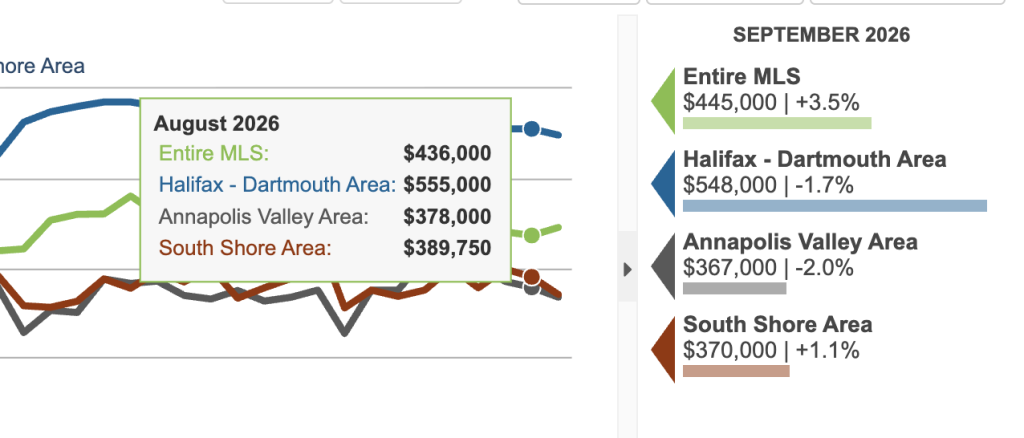
CTV Atlantic reported in late September that higher-priced homes are sitting longer in HRM. That matches what I’m seeing.
For buyers: you have time to do inspections, compare homes and negotiate. For sellers: pricing right on day one matters more than it has in years.
Annapolis Valley: Fourth Straight Month in Buyer's Territory
The Valley sat at 6.5 months of supply in September. It has now been above the six-month buyer’s market line since June.
- Sales: 131, down 3.0% YoY
- Median price: $367,000, down 2.0% YoY
- Median days on market: 37 days, actually 2 days faster than last September
- Homes for sale: 762, up 21.9% YoY
That days-on-market number tells me something. Homes that are priced well in our Valley communities are still moving. The listings that sit are dragging the averages around.
One flag for October: Valley pending sales fell to 121. That’s down 16.6% from last year. Pendings lead closings by about a month, so expect October sales to come in softer.
The Other 5 Regions at a Glance
Region | Median Price | YoY | Median DOM | Months Supply | Market |
South Shore | $370,000 | +1.1% | 47 | 8.2 | Buyer’s |
Northern | $317,900 | -3.7% | 29 | 7.1 | Buyer’s |
Cape Breton | $259,500 | +5.1% | 21 | 5.9 | Balanced |
Highland | $274,375 | -15.8% | 30 | 13.0 | Buyer’s |
Yarmouth | $314,950 | +26.0% | 81 | 8.7 | Buyer’s
|
Cape Breton is the fastest market in the province at 21 days. It’s sitting right at the edge of buyer’s territory, though. Inventory there is up 33.1% year over year.
A caution on Highland and Yarmouth. They recorded only 34 and 14 sales. With samples that small, a few unusual homes can swing the median a lot. I wouldn’t treat those price moves as a trend.
What the Economists & Analysts Are Saying
The Bank of Canada held its rate at 2.25% on September 2. That’s the seventh hold in a row. The Bank said upside risks to inflation have increased, mostly from energy prices and new US tariffs. The next decision is October 28.
Inflation is hitting us harder here. Nova Scotia’s CPI rose 5.1% in August, compared with 3.0% nationally. Energy prices in the province were up 22.1%, and fuel oil jumped 46.6%. Meanwhile, average weekly wages here rose only 3.0%.
That gap is a real squeeze. In my view, it explains a lot of the hesitation I’m hearing from buyers.
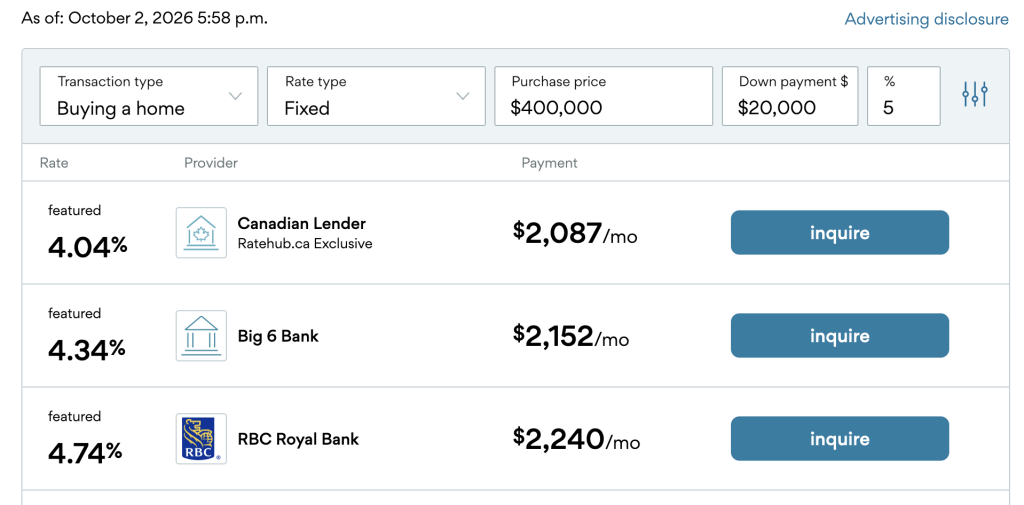
Fixed mortgage rates are drifting up too. Ratehub’s best 5-year fixed was 4.34% on October 1, while variable sat at 3.40%. Nesto reports that markets are now pricing in a partial hike by December.
Jobs are a bright spot. Nova Scotia’s unemployment rate was 6.1% in August, down slightly from July.
On new construction, CMHC data shows housing starts in Nova Scotia’s larger centres down 31% year to date through August. Nationally, they’re down about 4%. That slowdown will matter for supply in 2027 and beyond.
Daniel Foch wrote in REM that every province sold fewer homes in August than a year earlier. As he put it, “more competing properties arrived without a matching increase in purchases.” That’s exactly the Nova Scotia story this month.
What to Expect Over the Next 90 Days
Inventory always shrinks from fall into December as listings expire. Based on the last two years, here’s my read on where we land by year end:
- Halifax-Dartmouth: months of supply easing to roughly 2.7–2.8, still well above last December’s 2.1. I expect the median to stay between $535,000 and $555,000.
- Annapolis Valley: easing to about 4.5 months, back into balanced territory on paper. Softer October closings are likely, given weaker pendings.
- South Shore, Northern and Yarmouth: staying buyer-friendly, at roughly 5–7 months.
- Cape Breton: easing to about 4.5 months, still the quickest-moving market.
- Province: about 4.0 months by December, up from 3.2 last year.
The big risk is the October 28 rate decision. A hike, or even hawkish language, would push fixed rates higher and cool spring buying plans.
If You're Buying Right Now...
- Negotiate. With 4+ months of supply in Halifax, conditions on inspection and financing are reasonable asks again.
- Get pre-approved and hold your rate. Fixed rates are rising. A rate hold can protect you for up to 120 days.
- Look at homes that have sat. Listings past 30 days often have sellers ready to talk.
- Budget for energy costs. With fuel oil up 46.6%, ask for heating history on every home.
If You're Selling Right Now...
- Price for today’s market, not May’s. Halifax’s median is down $37,000 from its spring peak.
- Your competition is up nearly 20%. Presentation, photos and staging matter more than they have in years.
- Consider listing before the holidays. Fewer listings compete in November and December.
- Watch your first two weeks. If showings are slow, adjust early rather than chasing the market down.
Bottom Line
The Nova Scotia real estate market is not crashing. Sales are slower, choice is wider and prices are mostly flat. For buyers, this is the most room you’ve had in years. For sellers, it’s a market that rewards realistic pricing.
Data sources: NSAR MLS® via InfoSparks (© 2026 ShowingTime Plus, LLC) · Bank of Canada · Statistics Canada · NS Finance & Treasury Board · CMHC Housing Market Information Portal · Ratehub.ca · CREA · REM / Daniel Foch · CTV Atlantic
Dawn Magee, REALTOR® · Royal LePage Atlantic · 902-277-0510 · dawn@movenovascotia.com · movenovascotia.com · swiftdigs.com
Frequently Asked Questions
1. Is it a buyer’s market or a seller’s market in Nova Scotia right now?
Most of Nova Scotia is a buyer’s market as of September 2026, and Halifax has shifted to a balanced market. Halifax-Dartmouth reached 4.0 months of supply, the highest level in NSAR data going back to January 2021. The Annapolis Valley (6.5 months), South Shore (8.2), Northern (7.1), Highland (13.0) and Yarmouth (8.7) areas are all buyer’s markets. Cape Breton (5.9) is balanced but close to the line.
In plain terms: under 4 months of supply favours sellers, 4–6 months is balanced, and over 6 months favours buyers.
2. Are house prices going down in Nova Scotia?
Prices are mostly flat, with small year-over-year drops in Halifax and the Annapolis Valley. In September 2026, the Halifax-Dartmouth median sale price was $548,000 (down 1.7% from a year earlier). It’s down $37,000 from May’s spring peak of $585,000. The Annapolis Valley median was $367,000 (down 2.0%). The provincewide median rose 3.5% to $445,000, but mainly because Halifax made up a larger share of sales that month. The average price was essentially unchanged at $480,903 (down 0.1%).
3. Is now a good time to buy a house in Nova Scotia?
For buyers, fall 2026 offers more choice and negotiating room than any time since at least 2021. There were 4,508 homes for sale across Nova Scotia in September, up 17.5% from a year earlier. Homes are also taking longer to sell: the Halifax median was 27 days, up from 18. The main headwinds are costs. The best 5-year fixed mortgage rate was about 4.34% on October 1 and rising. Nova Scotia inflation was 5.1% in August, compared with 3.0% nationally. The Bank of Canada’s next rate decision is October 28, 2026.