

Canada's credit stress isn't a Rerun of 2008
but the shift underneath it deserves attention
Canada’s household debt story entered a more complicated phase this summer. Insolvencies climbed toward levels last seen during the financial crisis. Mortgage arrears rose to a decade-plus high. Forced sales in Toronto hit a record share of new listings. The headlines settled on a single word: crisis.
The data tells a narrower story, though, once it’s unpacked. Arrears remain low by both historical and international standards. The insolvency count needs a population adjustment that few outlets are making. And the debt growth driving the 2026 headlines is coming from a different source than it did heading into 2008. None of that erases the real pressure households are under. It does change what that pressure is made of. That distinction matters for anyone trying to make sense of it.
Arrears Remain Low, Not A Repeat Of 2008
Arrears is simply the term for a mortgage that’s fallen seriously behind on payments, usually 90 days or more. It’s one of the clearest signals of financial stress in the housing system. It shows how many households are struggling to keep up.
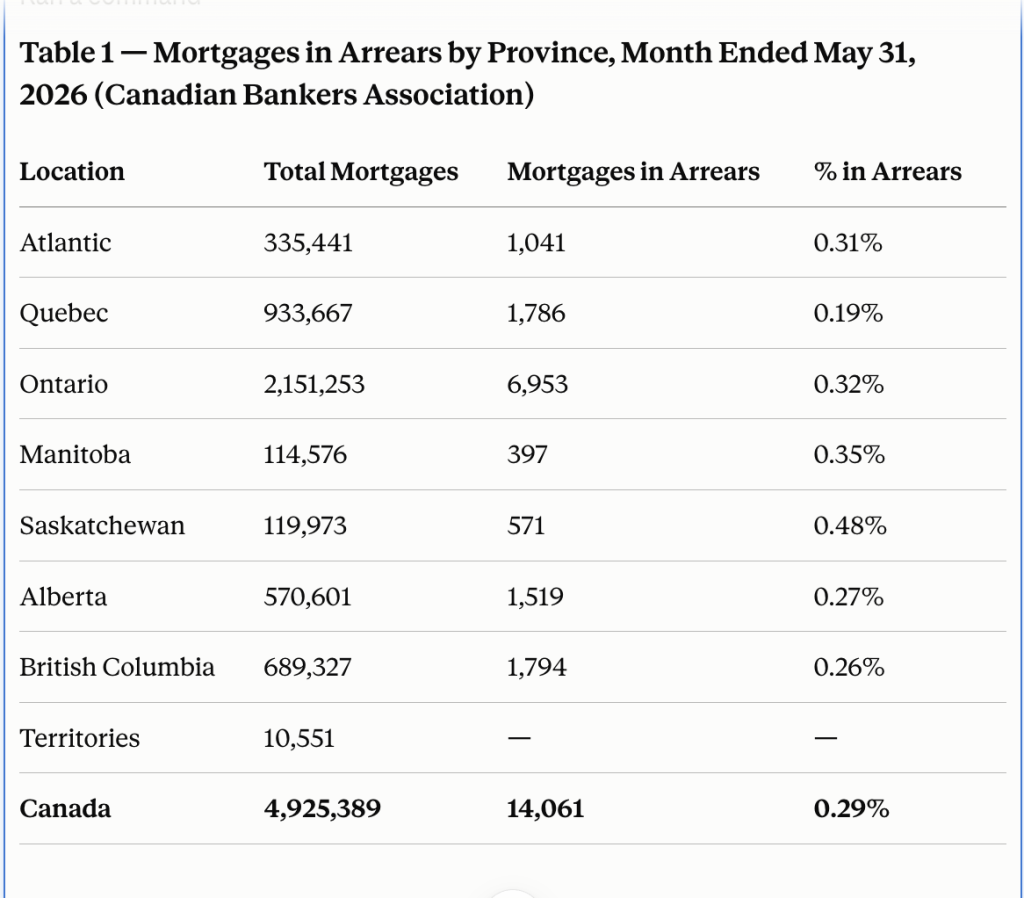
As of May 2026, 14,061 bank mortgages across Canada sat 90 or more days past due, out of 4.93 million total mortgages. That’s according to the Canadian Bankers Association. That works out to a national arrears rate of 0.29 per cent, less than one-third of one per cent of all mortgages. Atlantic Canada’s figure sits at 0.31 per cent, on 1,041 arrears out of 335,441 total mortgages. That’s only marginally above the national rate. Ontario is at 0.32 per cent. Neither region is standing out as a problem area.
The CBA’s own July 2026 release puts it plainly: arrears “remain very low compared to historical and international standards.” As of March 2026, Canada’s rate stood at 0.28 %. The UK’s rate was 0.66 per cent. The United States sat at 2.03 per cent, more than seven times higher than Canada’s. U.S. arrears cleared five per cent at the peak of the 2008 crisis. Canada isn’t within reach of that comparison and hasn’t been at any point in this cycle.
The Insolvency Count Needs Some Context
Statistics Canada’s second-quarter data has Canada on pace for its worst nominal insolvency year since 2009. On its own, that’s an alarming headline. But it leaves out one important detail: Canada’s population has grown substantially since 2009. Comparing raw insolvency counts across 15 years overstates the trend. It doesn’t adjust for how many more people now live here.
Scaled per capita, 2026 tracks closer to 2016 than to 2009. That’s still a real increase in financial stress. It’s just a smaller one than the nominal number suggests when it’s reported without that context.
Debt Is Still Climbing, But What's Behind It Has Changed
Canada’s household debt-to-income ratio measures how much debt households carry compared to what they earn. It moved from roughly 140 per cent in 2008 to a record 179.6 per cent in the first quarter of 2026. That’s according to Statistics Canada’s national balance sheet and financial flow accounts, released June 12. In plain terms, Canadians now owe about $1.80 in debt for every dollar of income they bring home. On the surface, that number argues against any claim that household borrowing has gotten healthier since the last crisis.
The type of debt driving that number tells a more useful story, though. Net mortgage originations, the value of new mortgage lending, fell to $22.6 billion in Q1 2026. That’s down from $26.3 billion the prior quarter. That’s the largest single-quarter drop since Q4 2023, as demand for mortgages softened alongside slower home resales. Total household credit market borrowing still rose to $35.5 billion in the quarter, though. Non-mortgage debt, things like consumer credit and lines of credit, more than made up the difference. Total household credit market debt reached $3.25 trillion.
What This Shift Actually Means
Heading into 2008, and through much of the 2016-2021 period, cheap home equity lines of credit financed a wide range of discretionary spending. Renovations, vacations, day-to-day costs that outran the paycheque. That kind of borrowing looks to have fallen out of favour. Canadians appear to have moved away from treating home equity as a general-purpose spending tool.
What’s replaced it is less reassuring. Households are increasingly turning to consumer credit instead, a far more expensive way to borrow. They’re using it to cover costs that look more like making ends meet than frivolous spending. The debt burden itself hasn’t gone away. It’s simply moved to a costlier form of credit. That form carries higher interest and fewer of the protections a mortgage offers.
Jobs Explain More of This Than Housing Prices Do
A Bank of Canada staff paper is cited directly in the CBA’s own release. It found that a one percentage point rise in unemployment tends to push the mortgage arrears rate up roughly 0.1 percentage points. That effect shows up with a lag of about a year. In other words, today’s arrears numbers are mostly telling us about the job market from a year ago. They’re not a real-time read on what’s happening right now.
On that front, the more recent picture has been improving. National unemployment stood at 6.4 per cent in July 2026, its lowest level in two years. It fell for a third consecutive month. Nova Scotia’s rate dropped to 6.2 per cent in July, down from 6.5 per cent in June. The province added 4,600 jobs that month and posted 2.4 per cent year-over-year employment growth.
The Real Pressure In Nova Scotia Is Cost Of Living, Not Housing
For Nova Scotians, the bigger squeeze isn’t coming from mortgage payments. It’s coming from the gap between what things cost and what people earn. Nova Scotia’s consumer price index, excluding food, rose 4.8 per cent in the year to June 2026. Food prices rose 3.3 per cent. Average weekly wages grew just 3.6 per cent over the same period. That gap leaves costs outrunning paycheques, even with a comparatively healthy local job market.
That gap shows up clearly in how people are responding. Roughly 31 per cent of Canadians now report having a side hustle. 85 per cent say they took one on out of financial necessity, not for extra spending money. A separate TD survey found roughly two-thirds of Canadians planned to cut spending in 2026. The deepest cuts are concentrated among younger respondents.
The Minimum Wage Debate
The province’s minimum wage sits at $16.75, with a further increase to $17.00 scheduled for this fall. That increase has become a genuine policy debate. The Fraser Institute has argued it risks reducing hours or accelerating automation among lower-wage employers. Workers, they say, could end up worse off despite the higher rate.
The Canadian Centre for Policy Alternatives sees it differently. They’ve argued the province’s high rate of precarious, unpredictable work is a policy choice rather than something unavoidable. Stronger labour standards, not wage restraint, would close the affordability gap, in their view. Both views are part of the current provincial conversation.
Defence And Clean Energy Are Providing A Counterweight
Nova Scotia’s real estate market spent much of the spring in a holding pattern. Both buyers and sellers deferred life decisions amid tariff headlines and broader economic uncertainty. That changed after March 2026, when the federal government announced more than $2 billion in defence investment for the province. There was an audible sigh of relief. That includes $1.2 billion for infrastructure upgrades at CFB Halifax Dockyard and Stadacona. It also includes $648 million for new hangar and drone infrastructure at 14 Wing Greenwood. After two years of very few postings in or out, 14 Wing Greenwood listings from April-June increased by 200-280% year over year.
Irving Shipbuilding’s River-class destroyer contract anchors the province’s aerospace and defence sector. It’s the largest defence procurement in Canadian history, worth an estimated $84 billion over its full scope. That sector already generates close to $2.6 billion in real GDP for Nova Scotia and employs more than 17,000 people. Those jobs tend to be stable and well-paying, tied to multi-year government commitments rather than short-term contracts.

Clean Energy Adds A Second Layer
Clean energy is a smaller but growing piece of the same picture. The $206-million Mersey River wind farm near Hunts Point is expected to employ more than 200 workers at peak construction. Its first phase is complete in 2027. The province’s ocean technology sector covers everything from marine defence to offshore wind. It’s positioning for further growth in the years ahead.
It’s worth keeping this in perspective, though. Nova Scotia’s overall real GDP growth is projected at a modest 1.0 to 1.5 per cent for 2026. This isn’t a anticipated to be a broad-based boom. It’s targeted growth in a handful of regions-Halifax Dartmouth, Annapolis Valley, and sectors, defence, clean energy and ocean technology. That growth sits on top of an otherwise soft provincial economy.
Provincial Spending Cuts Raise Their Own Questions
Nova Scotia’s 2026-27 budget carries a $1.19-billion deficit. It also carries a plan to reduce the civil service by five per cent annually for four years. A separate directive limits departments to filling only one of every two vacancies going forward. Justice and Social Development have absorbed the largest reductions so far, at 83 and 78 full-time positions respectively.
Finance officials have said the reductions will “most likely” be achieved through attrition and retirements. That means staff leaving or retiring naturally, rather than being let go. The province has already confirmed real layoffs, though. That includes a voluntary severance offer to 300 unionized staff in one department, with forced layoffs still possible if not enough people take the buyout. A full breakdown of where the cuts are landing isn’t expected until the 2027 budget. That leaves the public with limited insight into how these decisions are being made in the meantime.
Travel Nurses Show What Poor Allocation Looks Like
One example makes the case for closer scrutiny better than any budget line item could. Nova Scotia spent $141.7 million on travel nurses in the 2023-24 fiscal year alone. It exceeded its travel-nurse budget by a further $17.8 million this past year. At the same time, the president of the Nova Scotia Nurses’ Union has said publicly that some Nova Scotia-trained nurses leave the province to work as travel nurses somewhere else.
Better pay and more flexible schedules draw them away, while the province pays a premium to bring outside nurses in to fill the gap. Existing retention incentives, up to $5,000 for new graduates and $10,000 for a two-year commitment, haven’t resolved the outflow. Maritime provinces are now developing a joint public travel-nurse program to reduce reliance on costly private contracts.
The Backyard Suite Program's Real Barrier
The province’s Secondary and Backyard Suite Incentive Program ended in March 2026. It had offered a forgivable loan of up to $40,000 toward in-law and backyard suites. 624 applications were approved before it closed, and the funding was redirected to rent supplements instead.
The program’s structure limited how many people it could help. It worked as a post-completion reimbursement, not upfront money. That meant homeowners needed the full project cost already financed, or in savings and equity, before they’d see a cent back. Against current construction costs, that’s a steep requirement. Basement conversions into legal suites typically run $60,000 to $130,000 in Nova Scotia right now. Standalone backyard suites run $225,000 to $350,000 or more. A $40,000 reimbursement covers a shrinking share of either project. It does nothing to help someone who can’t front the money in the first place.
A federal companion program, a proposed $80,000 low-interest loan through CMHC, was never actually implemented. It was formally cancelled in the 2025 federal budget, despite considerable earlier publicity. What remains federally is insured mortgage refinancing, up to 90 per cent of a home’s post-renovation value. That still requires substantial existing equity to use. HRM’s own municipal grant, up to $13,000, remains active and was expanded in February 2026. It’s aimed mainly at permit and connection fees, though, rather than the bulk of construction costs. It should be noted that approximately 30% of construction costs are attributed to municipal development and permit fees.

CPP Investments Faces Similar Scrutiny
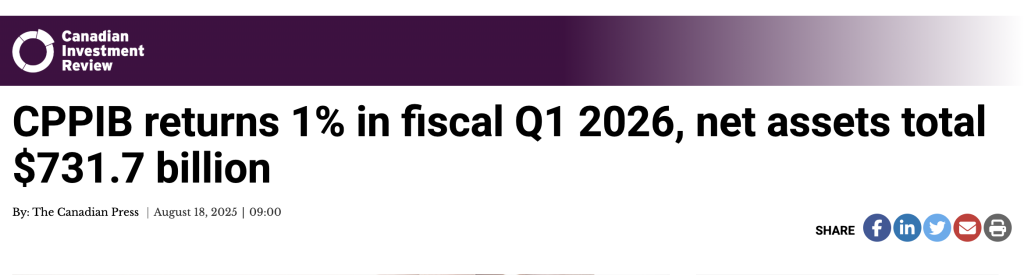
CPP Investments, the body that manages Canadians’ pension contributions, has drawn comparable attention. The fund changed how it measures its own performance starting in fiscal 2025. Even under that revised, more forgiving benchmark, it still missed its own target by 5.4 percentage points in fiscal 2026.
Executive compensation moved in the opposite direction. CEO John Graham earned approximately $7 million, on a bonus multiplier of 1.33 times target. The broader staff bonus multiplier rose to 1.10 from 0.62 just two years earlier. To be clear, CPP Investments posted positive returns overall, this isn’t a story about losses. The criticism centres on missing its own performance target while compensation climbed anyway. Governance commentators have called that a structural failure rather than simply a bad year.

Three Things Worth Watching
Three signals will show whether this cycle keeps diverging from 2008 or starts to look more like it. First, whether mortgage arrears growth continues to sync with the labour market’s roughly one-year lag or starts moving on its own. Second, whether the shift toward consumer credit, rather than mortgage debt, keeps driving household borrowing growth or will consumers start leaning on their home equity. That would suggest ongoing financial strain even if housing itself stays stable. Third, whether Nova Scotia’s targeted sector growth in defence, clean energy and ocean technology spreads into broader employment gains. Or whether it stays concentrated in a handful regions and handful of large contracts.
For now, the data supports a narrower read than the “credit crisis” headlines suggests.
Sources:
Canadian Bankers Association, “Mortgages in Arrears in Canada – What the Numbers Mean” (July 31, 2026) |
Statistics Canada, National Balance Sheet and Financial Flow Accounts, Q1 2026 (June 12, 2026) |
Bank of Canada |
Nova Scotia Department of Finance |
Government of Canada, defence investment announcements |
Fraser Institute |
Canadian Centre for Policy Alternatives (Nova Scotia) |
TD survey (January 2026) |
Omnisend Side Hustle Economy Report (2026) |
Halifax Examiner |
CBC News |
Canada Infrastructure Bank |
Yahoo Finance / PitchBook, CPP Investments coverage
Video references:
Toronto Forced Sales, Daniel Foch (https://youtu.be/t9a6RJ6332s) |
Homeowner Insolvencies Surge, Mark Mitchell (https://youtu.be/u6oKnAXMRmA) |
CPP Review, Millennial Moron, Part 1 (https://youtu.be/JGoLLWqNFuo) |
CPP Review, Millennial Moron, Part 2 (https://youtu.be/ac2xbTpOzeg)