 by Dawn Magee
Inventory Climbs, Prices Hit Record Highs, and Halifax Keeps Defying the National Narrative
While Canada’s housing market nationally is in a bit of an identity crisis — buyers hesitating, inventory building, confidence shaky — Nova Scotia in April 2026 is telling a different story. Prices just hit their highest point in years across most regions, inventory is rising but still nowhere near buyer’s market territory in HRM, and the spring market is showing real pulse. Here’s the full picture.
The Big Picture: Nova Scotia Overall
Nova Scotia’s MLS recorded a provincial median sale price of $471,500 in April 2026 — up from $460,000 in March, and the highest level since early 2025. Average sale prices hit $531,425, a notable jump. New listings surged to 1,752 province-wide, the strongest April listing count since 2022, reflecting growing seller confidence heading into spring. Active inventory reached 3,432 homes for sale and months of supply sits at 4.2 months — technically balanced, though it varies dramatically by region. Pending sales came in at 860, suggesting solid absorption heading into May.
The market temperature province-wide: Balanced-to-Balanced-Seller overall, but don’t let that average fool you. Halifax is a different beast entirely.
Halifax & HRM: Still Running Hot
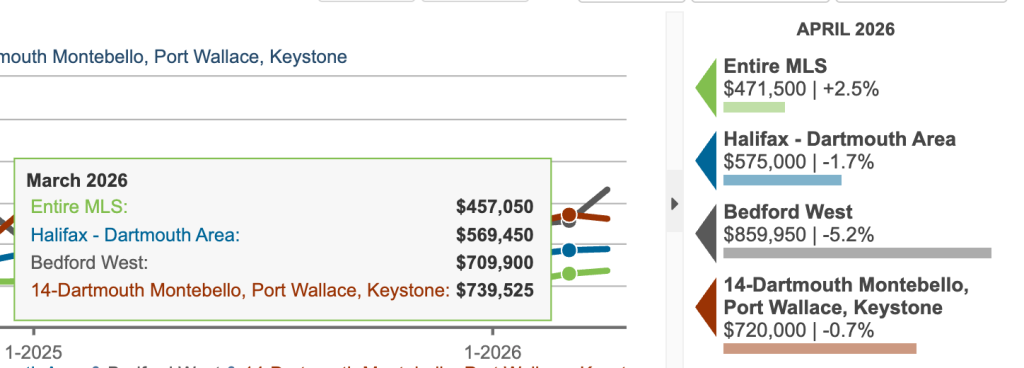
HRM posted a median sale price of $575,000 in April — up from $569,450 in March and the highest since mid-2025. Average prices hit a striking $666,215. New listings jumped to 827, the highest in recent months, yet the market absorbed it: pending sales reached 441 and months of supply sits at just 3.2 months — squarely in Seller’s Market territory 🟠.
Median days on market in HRM: just 7 days. Seven. Homes that are priced right and presented well are not sitting. Average DOM is 36 days, but that gap between median and average tells you what you need to know — most homes move fast, and the ones dragging the average up are outliers.
HRM’s story in one sentence: More listings are coming to market, but buyer demand is keeping up, prices are rising, and well-prepared sellers are winning.
HRM Sub-Market Note
Within HRM, the fastest-moving pockets continue to be the 7-to-10-day zones — typically Bedford West, Dartmouth waterfront/Montebello neighbourhoods, and established Halifax peninsula neighbourhoods. Fall River and Hammonds Plains tend to attract the family-with-backyard buyer segment that’s still very active. If you’re buying in HRM, you need to be pre-approved, decisive, and ready to compete, even to waive conditions in your offer.
Annapolis Valley: Best April Median on Record
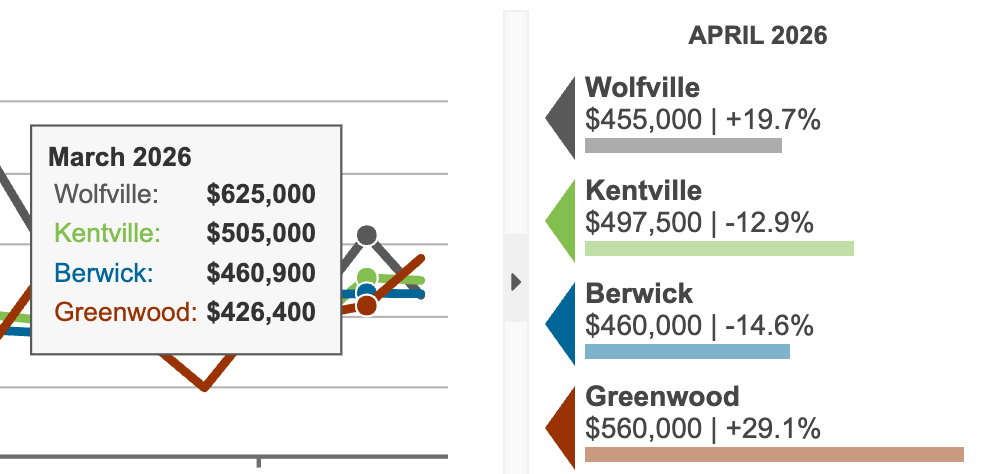
The Valley had a standout April, with Greenwood leading the pack due to a busy posting season for 14 Wing Greenwood. Median sale price hit $409,900 — the highest ever recorded in our data going back to January 2021, surpassing the previous peak of $387,500. Average sale price reached $413,108. New listings came in at 294 and pending sales at 122, with months of supply at 4.8 months — still Balanced-Seller territory 🟡.
Median DOM in the Valley was 21 days — moving reasonably quickly. Average DOM was 48 days, reflecting some rural and upper-end properties taking longer to move.
The Valley’s affordability premium relative to HRM continues to attract buyers — you’re getting more land, more home, and a laidback lifestyle for $130,000–$165,000 less than the Halifax median.
Valley Sub-Markets
Along with Greenwood during posting season, Wolfville is a consistently desirable market due to proximity to the university and wineries, driving higher pricing and faster sales. Windsor/Hants is catching up quickly as a value alternative to HRM commuters. Further down the Valley and therefore further away from HRM, the lower home prices here provides some affordability for first time home buyers.
The Other 5 Regions at a Glance
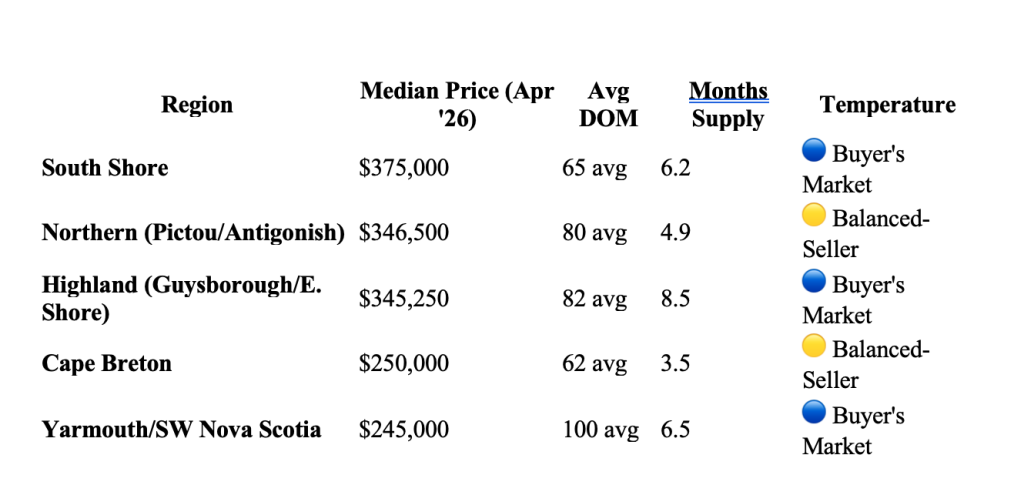
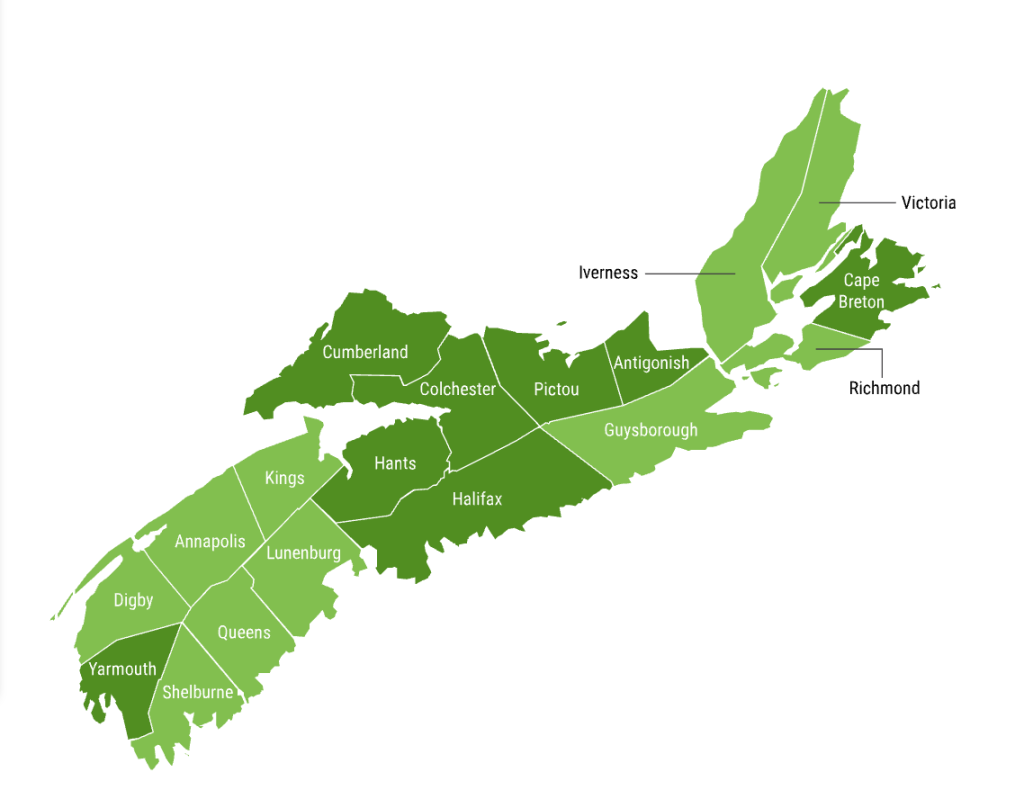
Cape Breton stands out here — at a $250,000 median with just 3.5 months of supply, it’s one of the most accessible markets in Atlantic Canada with solid demand fundamentals. The Highland region continues to struggle with the highest supply (8.5 months) and longest DOM of any NS area.
What the Economists & Analysts Are Saying
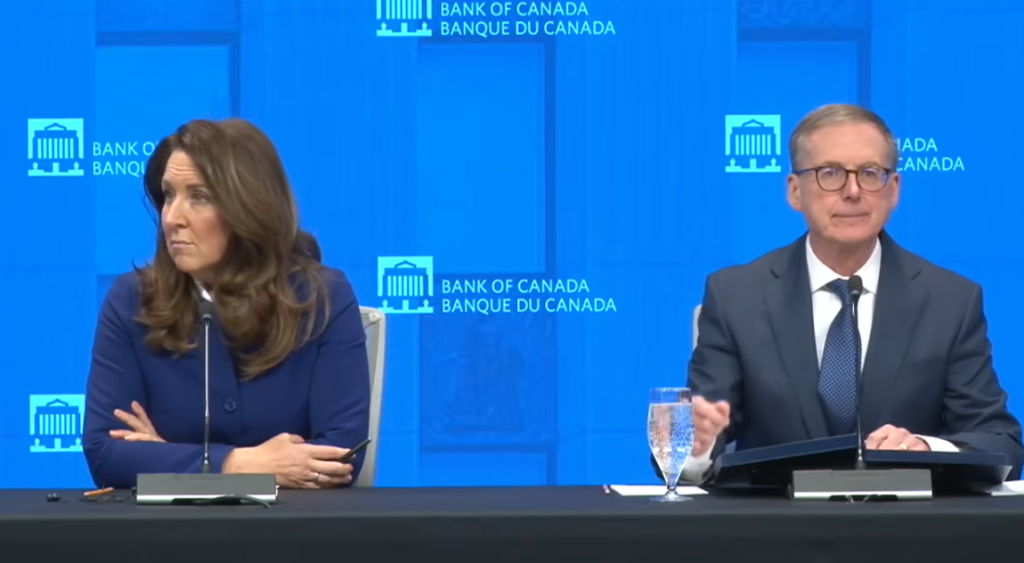
The Bank of Canada held its overnight rate at 2.25% on April 29, the fourth consecutive hold. The next decision is June 10. The Bank cited an oil price shock as a new inflation risk while also noting it could weigh on consumption and economic growth — a difficult balancing act. Variable mortgage rates remain steady at around 3.35–3.40%, while the best 5-year fixed insured rates sit around 4.04–4.09%, giving buyers meaningfully better purchasing power than the 5% rate environment of 2023–2024. True North MortgageRatehub
Nova Scotia is one of the bright spots in a choppy national employment picture. NS unemployment came in at 6.3% in April 2026, down 0.3 points month-over-month — one of the few provinces showing improvement while the national rate ticked up to 6.9%. Statistics Canada
Daniel Foch, host of Canada’s #1 real estate podcast, laid out the national picture clearly in his April 2026 column: buyers are stepping back at a time when they would normally be most active. But his broader “Age of Divergence” thesis is actually a strong argument for Nova Scotia — in Alberta, Quebec, and across much of Atlantic Canada, prices are more stable, demand has sustained, and available inventory is tight, contrasting with the softness in Ontario and BC. REM

On the mortgage side, Owl Mortgage (owlmortgage.ca) has been highlighting the impact of Bill C-4, which received Royal Assent March 12, 2026 — it includes a new first-time home buyers’ GST rebate on qualifying new homes, a middle-class tax cut, and the permanent removal of the federal consumer fuel charge. While it doesn’t directly change mortgage rates, the tax savings improve monthly cash flow for first-time buyers and renewal households — relevant news for Nova Scotians entering the market. Centum
The key wildcard nationally: U.S. inflation in April 2026 jumped to 3.8%, likely foreshadowing a similar jump in Canada’s next CPI, and the Iran conflict continues to push oil prices and bond yields upward. This is the reason fixed rates haven’t fallen further despite the BOC holding steady. If inflation remains stubborn, a standard 5-year fixed mortgage rate could hover between 4.5% and 4.9% by late 2026—a trend worth monitoring closely. True North Mortgage Mortgage Sandbox
What to Expect Over the Next 90 Days
HRM: Expect prices to hold or nudge 2–3% higher through July. Months of supply at 3.2 is still seller-friendly. The surge in new listings (827 in April, highest in recent months) will keep competition from becoming frenzied, but there’s no sign of a price correction. Buyers need to act — the “window” isn’t closing, but it’s not widening either.
Annapolis Valley: The $409,900 median in April signals the Valley homes have genuinely repriced upward. Expect the $390K–$420K range to hold through summer, with Wolfville likely pushing higher. Inventory at 4.8 months gives buyers slightly more breathing room than HRM.
South Shore & Yarmouth: These remain buyer-friendly with 6+ months of supply and longer DOM. Patient buyers with flexibility have real negotiating power here. No imminent price pressure in either direction.

Cape Breton: At $250K median with 3.5 months of supply, it has the characteristics of a market that could move. Strong buyer demand relative to inventory. Prices likely to hold or edge up 2–4% over 90 days. Sydney is approximately 5 hours from Halifax and is unique market.
MLS reporting timelines of firm offers and closed deals vary in the regions of the South Shore and Cape Breton compared to the rest of Nova Scotia as the realtors in these areas don’t post properties sale prices until closing day, whereas according to NSAR, properties sales prices are to be posted once conditions are firm.
Key risk province-wide: If the Bank of Canada raises rates later in 2026 (Scotiabank is forecasting hikes in H2 2026), it would dampen buyer confidence heading into fall. For now, the hold gives the market a stable foundation. Insolvencies are on the rise. The economy is impacting job uncertainty, and government layoffs have begun. Food and oil prices continue to rise, buyers are treading very lightly in this market.
Yes, there are sale increases, new listing increases, some sale price increases when compared to last year, but last year was one of the worst years since 2008. And these numbers are up month over month as typical lead up to the spring market.

Bottom Line
Nova Scotia’s April 2026 market is doing something the national headlines are missing; it’s holding its ground and, in some cases, advancing, even as Canada broadly contends with trade uncertainty, rising inflation risk, and cautious buyers. HRM remains a seller’s market with no signs of swinging the other way. Many sellers listing right now are spurred on by debt, death, divorce or downsizing. Whereas buyers are waiting to get what they want, within their budget and they are willing to wait, even if it means at a higher mortgage rate.
Questions about what this means for your specific situation? Let’s talk.
Data: NSAR MLS, April 2026 | Economic: Bank of Canada, Statistics Canada, CMHC | Analyst commentary: Daniel Foch (realestatemagazine.ca), Owl Mortgage (owlmortgage.ca)